Beyond the stadium: what the World Cup showed about matchday LED
The tournament is done and the fan zones have come down. What a month of football says about the screens on the walk in, in the bowl and well beyond it, and how that translates to Australian venues.
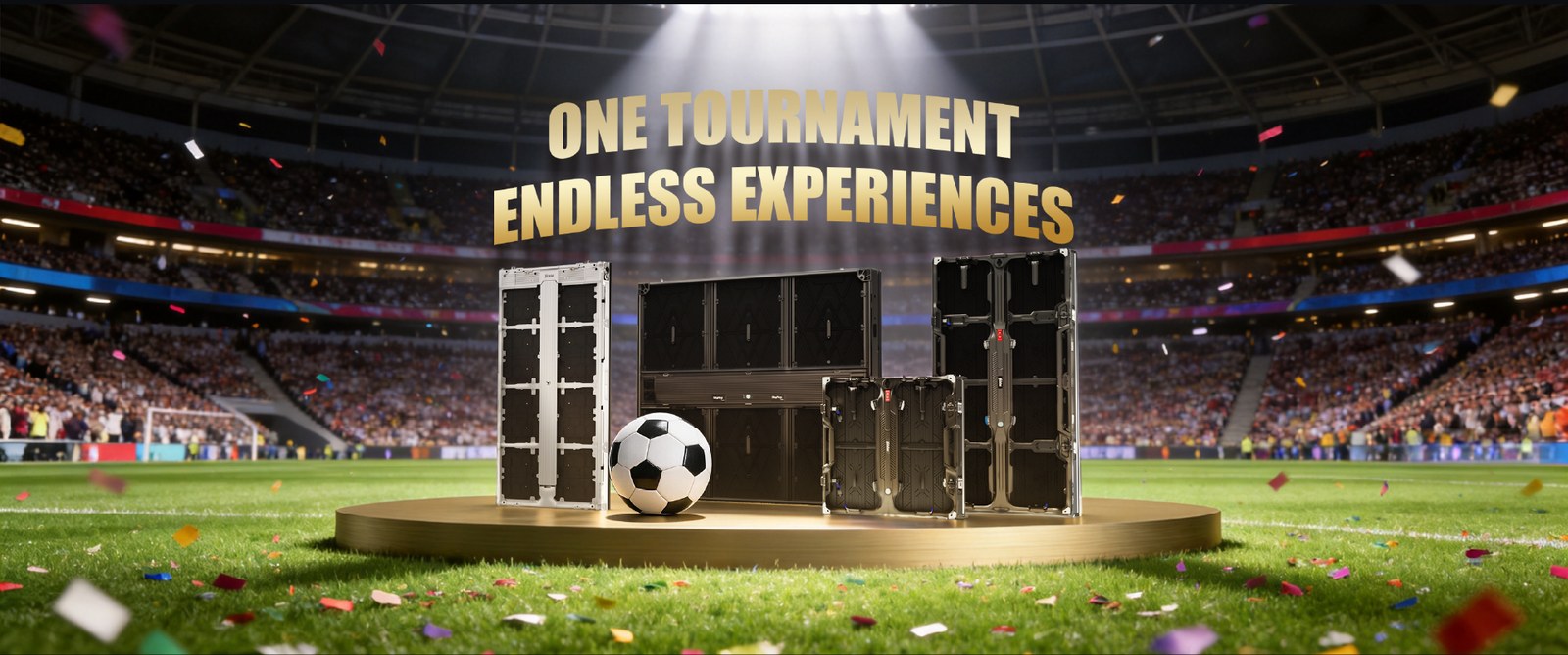
The World Cup finished on 19 July. For a month it did what only a handful of events can do, which is put the same pictures in front of most of the planet at once. Very few of those people were in a stadium. They were in squares, parks, bars and club rooms, watching on screens somebody had to specify, freight, rig and keep running. The screen people remember is the one hanging in the middle of the bowl, and it is almost never the only one doing work. Each part of the footprint asks something different, and specifying them as though they are the same job is where budgets go sideways.
The walk in
The approach is the part most often treated as an afterthought, and it is the part working hardest against the conditions. Forecourt and concourse screens sit in direct sun, carry wayfinding and sponsor content, and get read from ten metres rather than a hundred. That combination wants a finer pitch than the bowl and enough brightness to hold up at three in the afternoon in February.
The Dicolor MP Series is built for exactly that. Pitches from 2.6mm through to 10mm, up to 10,000 nits on the coarser models, IP65, and front and rear service so a cabinet sitting in a tight concourse cavity is still reachable when it needs to be.
The bowl
Inside, the requirement flips. Viewing distances stretch, content is live, and the screen has to stay legible through a summer afternoon and a broadcast lighting rig without drifting in colour across a season.
The ME Series covers the large-format work: 6.67mm to 10mm, 7,500 to 10,000 nits, IP66 and IP69K, in a 75mm cabinet that does not eat structure. For perimeter and large-format advertising, the F2-100 is the slimmer P10 option. Neither is exotic. Both get specified because a stadium screen that fails at seven o'clock on a Saturday is not a warranty conversation, it is a broadcast one.
The fan zone
Then there is everywhere else, and this is where the tournament made its point. Live sites, club functions, sports bars, precinct activations, the temporary screen that goes up on Friday and comes down on Monday. Across a World Cup month, far more people watch this way than through a turnstile. This is rental territory, and the specification that matters most is not brightness. It is how fast the thing goes together and how many shapes it will make.
The AFV3 Series is built around that. Die-cast cabinets from 1.9mm to 4.8mm, 500x500 and 500x1000, a curve-lock that sets up by hand, front and rear service, and 8.5kg a cabinet at the light end. A crew that can rig it in an afternoon is worth more than another line on a spec sheet.
Why Australian venues make this harder
Two things separate the local job from the overseas version.
The first is light. Australian daylight is not a European afternoon, and brightness figures that read as generous on paper are ordinary here. Specify for the worst hour the screen will face, not the average one.
The second is that our venues rarely serve one code. A ground hosts AFL one weekend, an A-League fixture the next, and a concert the week after. Screens that reconfigure, or that sit alongside rental product without a visible colour mismatch, earn their keep here in a way they do not in a single-tenant stadium.
The WIN Entertainment Centre cube is the clearest local example: 66 square metres across four faces, switching between game-day and event configurations, and holding up under broadcast lighting. You can see it alongside our other sport and stadium case studies.
The short version
Treat the approach, the bowl and the fan zone as three jobs, not one. Specify brightness for the conditions the screen will actually face rather than the number on the brochure. And if a venue runs more than one code, ask how the screens will look next to each other in year three, not just on opening night. A World Cup makes the point at maximum scale. A Saturday night makes it every week.
If you are scoping a venue, that is a conversation we are always happy to have. Our major event LED solutions page walks through the three zones in more detail.
This article follows Dicolor Global's Beyond the Stadium: How LED Displays Create Modern Football Experiences, written for the international market.
Dicolor Quality - Beyond Expectations
Planning a venue screen?
Tell us the footprint and the calendar, and we will scope it.
LED screen display technology for the Australian market. Australian-based sales, technical and service support.